


In the mountainous portion located to our left in the painting of Saint Anne, Leonardo da Vinci concentrates a nucleus of mirabilissime invenzioni. This area corresponds to the system of hills between Bocca di Magra, Lerici, the mouth of the Magra River, the sea, and the Gulf of La Spezia up to the bay of Porto Venere — all located in the Province of La Spezia, Liguria, Italy — already reconstructed in the page dedicated to the real landscape of Saint Anne. For a full understanding of the geographical structure upon which these images are integrated, prior reading of that analysis is recommended. The figurative nucleus embedded within it cannot be understood if approached as a sequence of independent images.
The work itself takes shape as a complex construction, in which observation, memory and invention progressively integrate into a single organism, the result of a long elaboration that accompanies the artist until the last years of his life.
Within this construction, the mountainous area to the left of the painting hosts four intentional images: a battle composition and three human compositions, among which the self-portrait of Leonardo himself emerges as the central element.
The images identified in this portion of the painting do not occupy separate sectors, nor are they distributed autonomously. They share the same pictorial space, use common portions of form, and are constructed through a network of overlaps, continuities of strokes and shared details.
Among the mirabilissime invenzioni identified in Saint Anne, the one commonly known as the “Affogato” serves as a point of reference, in relation to its position in the mountainous portion to the left of the painting.
The presence of a recognizable male face in this area was also noted, within critical scholarship, by Federico Zeri, who reported the observation of some scholars regarding a figure emerging from the mountainous formations of the landscape.
The Affogato constitutes only one of the possible configurations emerging from this mountain formation. The same structures, observed from different orientations, reveal new intentional configurations attributable to the system of mirabilissime invenzioni.
In the same mountainous area to the left of the painting, rotated 90° clockwise, it is possible to identify a further intentional image, attributable to a battle composition.
In the proposed elaboration, the same rotated portion of the image is accompanied by a white oval that delimits the area in which the face of the battle composition can be recognized. The oval does not alter the original image, but has the sole function of visually circumscribing the area of interest.
Only at a later stage, the reading of some passages of the Treatise on Painting provided textual confirmation of the presence of battle compositions among the mirabilissime invenzioni that the artist indicates as concealable within the limbs of landscapes and rocks.

The portion of the painting, observed through rotation, is here accompanied by an oval indicating the area in which the battle composition can be recognized. The oval does not modify the original image, but serves only to circumscribe the area of visual interest, allowing a first identification of the figure integrated into the landscape.


As a visual comparison, two drawings of warriors’ heads attributed to Leonardo da Vinci are placed side by side here, preserved at the Museum of Fine Arts in Budapest and related to studies for the Battle of Anghiari, an artwork now lost. The comparison highlights formal and stylistic affinities with the face identified in the landscape of Saint Anne, allowing the latter as well to be related to the typology of battle compositions.


To facilitate the reading of the battle composition, if it is not immediately perceptible, the image is made more legible here through a 90° clockwise rotation of the upper-left portion of the landscape. By hovering the mouse (or pressing and holding on a touch screen) it is possible to display a support overlay whose sole function is to guide observation. The highlighted margins should not be understood as exact contours of the figure in the painting. In the pictorial technique of sfumato such margins are never rigidly defined: the image is not delimited by sharp lines, but is constructed through tonal variations, relations of light and shadow, and continuity of forms. The graphic overlay therefore has an exclusively indicative purpose. In the original painting it is the pictorial cues— and not an explicit tracing— that allow the face to form in the mind of the observer, through a progressive visual process consistent with Leonardo’s pictorial practice.
By enlarging the digital image, the details become clearly distinguishable: the eye, eyelashes, the nostril and other coherent anatomical elements. The real size of the face, in the painting, is about 35 cm.
Continuing the observation of the same mountain formation, and further varying its orientation, a rotation of approximately 96° clockwise reveals a different organization of forms.
In this configuration, the light line that in the previous reading delimited the battle composition takes on a decisive function. What appeared as a simple separation from the rest of the mountainous formations now becomes a luminous threshold that initially prevents grasping the completeness of the structure of a three-quarter male face, belonging to the human compositions, commonly known as the “moustached face”.
The light line corresponds to a true line of light: from the left eyebrow it descends diagonally along the nose and delimits the right side of the face down to the moustache area. In this new reading, the left side of the battle composition becomes the right side of this face.
The two readings also share the same ocular stroke, readable as the left eye in the first case and as the right eye in the second, according to a coherent transformation of the figure’s orientation.


In this portion of the landscape the light line acts as a visual threshold. In the previous reading it separates the battle composition; in the following reading, while belonging to the same pictorial structure, it initially interrupts the continuity of the profile of the human composition, making its perception less immediate. By hovering the mouse on the image (or pressing and holding on a touch screen) the light line becomes visible. This highlight aims to make explicit the element that, in the original painting, functions as a perceptual obstacle and, at the same time, as a passage point between two different readings.
The perception of this foreground figure, and of its relation to the background, is in this case more complex than that of other images in the same area. After observing the battle composition, attention tends to remain anchored to that first reading: it is necessary to deliberately shift focus to this new face.
If isolated within the oval, the face appears monumental in size. One can clearly distinguish the hair on the left side, rendered as a compact dark mass, abruptly interrupted at the top, a broad and well-defined nostril, and a pair of descending moustaches partially covering the mouth, making its reading less immediate.

The oval delimits the area of the face, isolating it from the landscape context. Reducing the tonal variations of the background makes it possible to distinguish more clearly the structure of the face and the main elements composing it.


By hovering the mouse on the image (or pressing and holding on a touch screen) it is possible to display a support overlay that accompanies observation, making more legible the continuity of the profile of the human composition.
This face is the largest portrait ever produced by Leonardo.
Its real size is about 45 cm.
The image occupies almost the whole
mountainous area to our left.
When viewing the work in person,
as at the Musée du Louvre,
perception requires tilting the head to the left,
consistent with the rotation previously indicated.
The face of the composition of a man appears, in the first orientation, stern and almost tense. The sweep of the mustache and the downward lines of the mouth suggest a tension that stiffens the expression.
But the configuration is not final. By rotating the image further, and thus varying the viewing point again, the same lines reorganize themselves. To perceive this transformation more clearly, one must go as far as about 110° to the left when viewing the original in person (equivalent, on a digital image, to a rotation of about 110° clockwise). What previously dominated the reading loses centrality, and the mouth, only lightly indicated, articulates differently.
The effect is surprising: the face that appeared stern gradually transforms into a face that smiles.
No new element is added. The same forms, the same strokes, produce a different expression. The transformation is not pictorial, but perceptual.
It is difficult not to recognize, in this passage, a playful component: Leonardo seems to guide the observer through an initial tension and then release it into a smile. What he truly intended to express remains open to interpretation; what is evident is the intention to create an effect that is conscious, controlled, and charged with subtle irony. It is no surprise that the smile emerges precisely when the observer is forced to push beyond the comfort of their own balance.

In the more advanced configuration of the rotation, the mustache area loses perceptual centrality, while a different articulation of the mouth becomes legible. The same lines, already present in the painting, now take on a different function in constructing the expression. The eye—unchanged in structure— appears more relaxed, and the whole recomposes into a face that smiles.
This image represents the culmination of the system of mirabilissime invenzioni integrated into the mountainous portion to the left of the painting. To grasp this new organization of forms, the landscape portion must be observed through a rotation of about 72° clockwise. After the battle composition and the human compositions analyzed above, observation converges on a figure that not only occupies a central position in the visual space, but assumes a structural role in the overall economy of the work.
The figure that emerges at this stage can be related to the self-portrait of Leonardo da Vinci. Its presence does not appear as an isolated episode nor as a marginal citation, but as the coherent outcome of a sequence of images developing within the same landscape and according to the same constructive rules.

The oval delimits the area in which
Leonardo’s self-portrait can be identified.
In this reading,
the dark mass of the hair
belongs to Leonardo’s figure,
yet coincides with strokes and volumes
that in the previous readings
contributed to the construction
of the “moustached face”
and, by continuity of form,
to the beard of the so-called “Affogato”.
Likewise,
portions that in the previous reading
participated in the battle composition,
especially in the upper zone of the face,
assume here a different function
in the definition of the self-portrait.
A stroke that was readable as an eye
in the overlapping images
is reorganized
as an element of the mouth.
The real dimensions of the face,
in the painting,
are close to life size.
In direct observation of the work, as at the Musée du Louvre, the rotation of the image corresponds to the inclination of the viewer’s head. This principle of equivalence between rotation of the image and rotation of the viewing point is illustrated on the page “How to Observe Hidden Images”, and is the basis of the reading method adopted here.
Compared to the human composition known as the “moustached face”, the tonal organization of the background is more homogeneous here, making the separation between figure and context less complex.
The reading of the foreground figure is, however, more complex. The lighter area of the landscape — corresponding to the body of water of the Gulf of La Spezia — functions as a line of light descending from the eyes toward the nose and continuing into the lower section, suggesting an illuminated portion of the beard. The profile of the nose is not fully defined and must be mentally reconstructed; the left eye appears only faintly indicated, and the upper part of the forehead is likewise absent. This mode of representation, common to the mirabilissime invenzioni, prevents immediate perception and requires a progressive reading, grounded in volumetric continuities rather than in explicit contours.


If the reading of the self-portrait
is not immediately perceptible,
the image is here observed
by rotating the mountainous portion
to the left of the painting
by 72° clockwise.
By moving the cursor over the image
(or pressing and holding on touch screens),
it is possible to display a support overlay
that accompanies the observation.
As the contact is prolonged,
a further visual aid appears
that makes certain features of the face more legible,
in particular the eye, nose and mouth.
The highlighted margins
should not be understood
as exact contours of the figure.
In the pictorial technique of sfumato,
the image is never defined
by sharp outlines,
but is constructed through
tonal variations,
relationships of light and shadow
and continuity of forms.
The graphic overlay therefore
has a purely indicative function.
In the original painting,
it is the pictorial indications —
and not an explicit tracing —
that allow the face
to progressively form
in the mind of the observer,
according to a visual process
consistent with Leonardo’s pictorial practice.
In this case, the technique employed by Leonardo does not consist only in making an image emerge through sfumato or overlapping strokes, but in constructing a configuration that becomes readable only from a specific line of observation.
The self-portrait is therefore not a figure that “is always there” and that the eye can recognize under any condition: it forms when the observer assumes a determined viewpoint (72° in the case of the rotated image). By shifting even a few degrees, the same forms return to function as simple ridges and peaks of the landscape, and the figure loses coherence.
This is a principle analogous to that found in some contemporary works based on perceptual alignment: heterogeneous elements, viewed frontally, appear as incoherent fragments, but from a single viewpoint they recombine into a unified image. In the case of Saint Anne, such recomposition occurs entirely through painting, light and tonal gradations, without introducing explicit outlines.
The images that follow present a series of visual and formal comparisons between details of the self-portrait identified in Saint Anne and corresponding details drawn both from other works certainly attributed to Leonardo da Vinci, and from the same Saint Anne. The comparisons concern specific elements— such as the eye, eyelid, eyebrow, eyelashes and relations of light and shadow— observed in their graphic and painterly construction, in order to verify stylistic and technical coherence within the same visual language.

The image presents a comparison
between the detail of the right eye,
half-closed, of the self-portrait identified in the Saint Anne
and the right eye of Saint Anne’s figure
in the same painting.
The comparison makes it possible to observe
coherence in the construction of the detail:
the handling of the eyelid,
the rendering of eyelashes and eyebrow,
the strokes defining the upper shadow of the nose
and the orientation of the pupil,
turned downward.
In both cases
the eye is not outlined
by an explicit contour,
but built through
tonal variations and overlapping marks,
according to a coherent painterly mode
recognizable
within the same work.

The image proposes a comparison
between the detail of the right eye
of the self-portrait identified in Saint Anne
and the right eye of the
red-chalk self-portrait of Leonardo da Vinci
preserved at the Royal Library of Turin
.
The comparison allows one to observe
significant analogies
in the rendering of facial details
in the periocular area:
the wrinkles
and eyelid bags
are built according to
coherent graphic and painterly procedures,
highlighting continuity
in the way Leonardo
structures and models
the area beneath the eye.

The image proposes a comparison
between the detail of the mouth
of the self-portrait identified in Saint Anne
and the mouth of an old man figure
depicted in a drawing by Leonardo da Vinci,
executed in the artist’s later years.
The comparison highlights
analogies in the construction of the detail:
the rendering of folds around the mouth,
the structure of the lips,
and the way the stroke
suggests the relaxation of tissues
are coherent in both images.
In both cases
the mouth is not delineated by a sharp contour,
but built through
overlapping strokes and tonal variations.
The comparison drawing
is known as Old Man with Water Studies
and is preserved as a graphic study
attributed to Leonardo da Vinci
(source:
Wikimedia Commons
).
The comparison helps verify
formal and stylistic continuity
in the rendering of mature facial features.
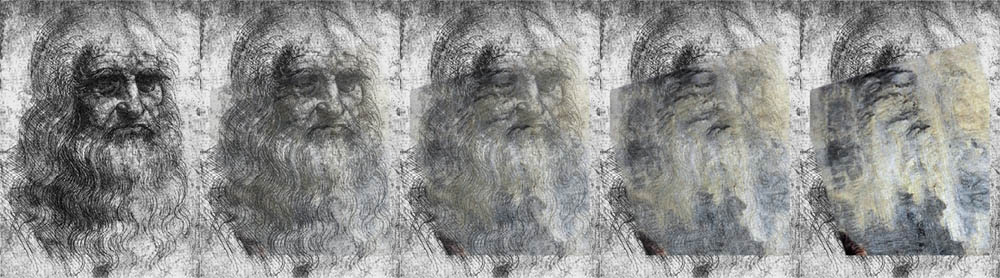
The sequence of images presents a progressive overlay between the self-portrait of Leonardo da Vinci preserved at the Royal Library of Turin and the self-portrait identified in Saint Anne. In the sequence, the Turin self-portrait constitutes the lower layer, consistently maintained at 100%, while Saint Anne self-portrait is progressively integrated as the upper layer.
The progression is as follows: Ar TO refers to the Turin self-portrait, and Ar S.A. to Saint Anne self-portrait.
In all configurations, the Turin layer remains at 100%, while the fill value of the upper layer (Ar S.A.) is progressively varied.
Observed in sequence, the overlay highlights the correspondence of the essential structural parts that define the face in both self-portraits. The progression makes it possible to perceive a formal continuity, rather than a simple juxtaposition of images.
The procedure adopted for the creation of this sequence is technically replicable. Digital reproductions of the originals preserved at the Royal Library of Turin and the Musée du Louvre were used. The image of the self-portrait identified in Saint Anne was rotated approximately 72° clockwise, in accordance with the orientation required for its proper reading. Since both images display low tonal contrast, a slight adjustment of the midtones (central value set to 0.85) was applied solely to improve legibility, without altering the structural integrity of the forms. The two images were then superimposed, keeping the Turin layer fixed at 100% while progressively varying the fill value of the upper layer (Ar S.A.), thus making the structural continuity of the corresponding parts verifiable.

The intermediate configuration (Ar TO 100% – Ar S.A. 75%) makes particularly evident the structural continuity of the corresponding parts. In this transitional phase, the face does not yet appear fully replaced, but clearly reveals the coherence of proportions, structural lines, and volumetric construction. The effect is not that of an arbitrary superimposition, but of a progressive formal convergence.

The image highlights, within the red oval, the peak of a hill depicted in the landscape of Saint Anne. These are a few simple strokes that precisely describe a ridge painted in the hill situated above the area of the Roman villa of Bocca di Magra.
When these strokes are observed as if they were merely the peak of a hill (within the red oval in the previous image), the profile of the ridge appears anomalous in relation to the rest of the landscape. The hill is constructed with slightly more pronounced and concentrated marks, which do not follow the same morphological logic as the surrounding formations. Why represent a peak in this way? A closer analysis provides the answer: those small, more incisive strokes actually constitute the structural elements that make possible the overlapping of forms in the compositions of men and battles.

The image shows the same detail highlighted in red
in different configurations.
The same few and simple strokes form:
1) the nose of the Affogato;
2) the left eye of the battle composition;
3) the right eye of the male composition (face with moustache);
4) the same eye in its smiling configuration (smiling face);
5) the mouth of Leonardo’s self-portrait.
These are not independent configurations,
but the intentional construction of the same graphic nucleus
designed to sustain multiple overlapping images.
The principle does not consist in adding new forms,
but rather in perceptually transforming the same structures
through variations of orientation.
This procedure makes the immediate identification
of the figures more complex,
since a single element simultaneously participates
in different structural organizations.
It is precisely this type of construction that,
in Leonardo’s own words,
“will be the cause of bringing you honor”:
the ability to transform a few strokes
into complete and multiple forms,
without compromising the coherence of the landscape.
Beyond the reasons described above, the hidden images in the mountain group under examination are distinguished from the other mirabilissime invenzioni for an additional reason: their organization follows a recognizable geometric structure.

The main figures of the work form a pyramidal composition (also known as triangular composition), a solution widely used by Renaissance painters to ensure visual balance and stability. The face of Saint Anne constitutes the apex of the pyramid, while the other figures define the sides and volume of the triangle.

The elaboration highlights the directional lines corresponding to the head inclinations
required to observe the different hidden faces:
1) Leonardo’s self-portrait;
2) the battle composition;
3) the face with the moustache;
4) the smiling face.
The inclinations are distributed according to a structure coherent
with the pyramidal layout of the composition,
showing how form and mode of observation
follow the same triangular scheme.
This correspondence between compositional structure and arrangement of visual readings does not replace close observation of details, but reinforces it: it indicates that the images are not distributed randomly, but integrated within a unified framework. In other words, even the very act of observing (and the different inclinations required to bring the faces into view) is coherent with the overall organization of the painting.

The image becomes readable through a 90° counterclockwise rotation of the upper portion of the landscape. Within the oval one can distinguish a male profile, integrated into the structure of the rocky formations; near the mouth, small circular elements suggest the idea of air bubbles, from which the traditional name “Affogato” derives.