


In the previous pages I presented the hidden images in Saint Anne through digital elaborations and image rotations. This is possible on a computer. In front of the original painting at the Louvre, however, the work cannot naturally be rotated. How can these images be observed directly on the original?
The images were integrated into the painting so that they can be perceived without changing one’s position in front of the work, but simply by tilting the head to the right or to the left. These indications are intended above all for direct observation of the original painting at the Louvre.
Tilting the head toward the right shoulder, in front of Saint Anne, changes the viewing angle by approximately 90° clockwise (equivalent, in digital elaborations, to rotating the image 90° counterclockwise). From this configuration it is possible to perceive the Affogato and the Devil.
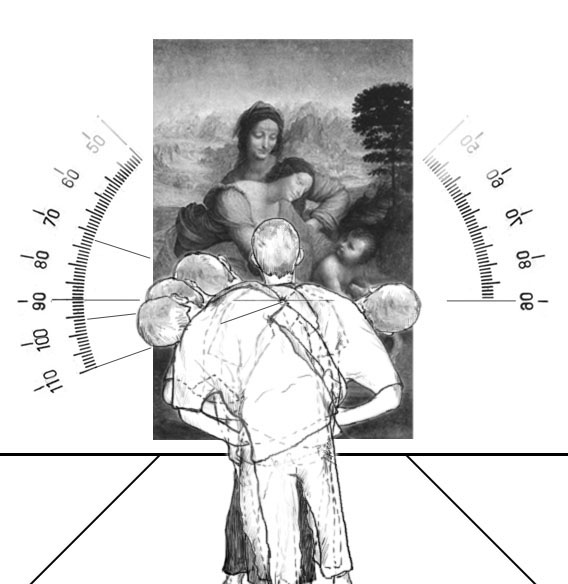
Tilting the head to the left, the images emerge progressively (see the elaboration above). The first is Leonardo’s self-portrait. The optimal viewing angle is approximately 72° to the left (equivalent to rotating the image 72° clockwise). Continuing the inclination to about 86°, the face with the moustache becomes visible.
Around 90° one can observe the battle composition and the Kite (bird). The face with the moustache is particularly evident around 96°, but may be perceived up to approximately 106°, depending on the observer’s sensitivity in distinguishing the foreground figure. Continuing further to the left, almost to the physical limit, one may finally perceive (around 110°) the smiling face.
